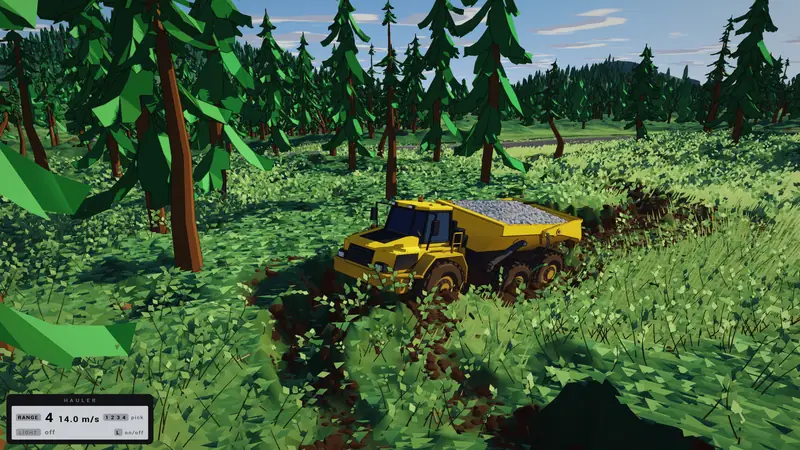
One Persistent Site Simulation Across Your Entire Save
Most construction games isolate digging inside tiny scripted patches while the surrounding hills remain frozen static geometry. Dirt Town replaces that split completely: the entire play site runs inside one unified soil and terrain simulation. You can plow, dig, haul, and stack material anywhere on the map at any time, and every change remains permanently stored in your save.
Everything in the environment is destructible—some formations are simply much harder than others. Clearing a shortcut may require felling timber, crushing surface brush, prying out embedded rocks, or cutting through dense subsoil layers before a loaded truck can climb smoothly.
| Material / Factor | Physical Behavior in Dirt Town | Recommended Engineering Response |
|---|---|---|
| Sand | Granular, low cohesion, slumps easily under steep slopes | Keep ramps shallow (AUTO grade) or cap running lanes with crushed gravel |
| Clay | Distinct layered cohesion; turns slick and rut-prone when wet | Cut side drainage ditches and top high-traffic bends with crushed aggregate |
| Crushed Gravel | Produced via Gravel Crusher; locks roadbeds together | Spread with Dozer (J + N float) and finish with the Compactor |
| Hard Rock & Boulders | High excavation resistance; resists casual dozer pushes | Drill rock anchors on foot to hook, lift, or haul boulders clear |
| Moisture & Rain | Reduces tire grip, softens soil, feeds creeks & puddles | Crown roads slightly (H tilt) and trench swamp basins downhill |
Layered Materials: Sand vs. Clay vs. Gravel
Skyturns engineered Dirt Town around stacked soil strata rather than one uniform "dirt" material. Sand behaves completely differently from clay in blade resistance, angle of repose, wheel sinkage, and how loads spill out of an excavator bucket.
When you excavate a fresh mining pit, peeling back organic topsoil and roots exposes distinct mineral seams underneath. Dumping wet clay directly onto a haul road can actually worsen traction during heavy rain, whereas crushing harvested stone in a Gravel Crusher yields coarse aggregate built specifically for road reinforcement. Once spread cleanly with a dozer blade and rolled flat with a Compactor, crushed gravel supports high-speed Range 4 passes without tearing apart after three haul cycles.
Moisture, Flowing Water & Swamp Drainage
Water in Dirt Town is active hydrology rather than painted blue polygons:
- Moisture Grip Penalties: Soil moisture directly alters both traction and how easily dirt shears beneath tires or tracks. Deep puddles soften subgrades and force loaded 6x6 haulers back down into Range 1 or 2.
- Rain Creates Real Creeks and Puddles: Rainfall accumulates across low terrain, forming flowing creeks that cut across low-lying haul corridors unless you grade culverts, raise gravel berms, or cut diversion ditches alongside your road.
- Swamp Drainage Side Mission: One signature contract tasks your crew with draining a flooded swamp to unlock buried deposits. Because water flows continuously toward lower elevation, digging a clean outlet trench with the Tracked Excavator lowers the water table organically.
Mining, Conveyors & Real-World Terrain Roots
At Early Access launch on December 4, 2026, Dirt Town opens with a dedicated mining and resource extraction map. Your progression pipeline scales naturally from rugged pioneering to industrial automation:
- Wilderness Trailblazing: Scout ore seams on foot, fell interfering trees, and pioneer a rough route for your first hauler.
- Stabilized Haul Corridors: Upgrade soft dirt ruts with crushed gravel and compactor passes so heavy shipments move reliably.
- Conveyor & Fleet Expansion: Reinvest contract earnings into bigger machines, gravel crushers, and conveyors that carry extracted material continuously out of deep pits.
- Side Contracts & Track Building: Between ore shipments, bank dirt into custom jumps for the dirt bike, build cliff jumps, or clear flooded lowlands.
Pit Stability, Crowned Roads & Drainage Engineering
Because soil in Dirt Town responds physically over the lifetime of your save, sloppy earthworks come back to haunt you later:
- Terrace Deep Pits: If you undercut a steep sand wall vertically, loose upper layers slump back into your loading zone. Bench deep cuts in stepped tiers so the excavator sits safely above falling sand.
- Crown High-Traffic Bends: Using the dozer's
Hfree tilt subtly along corners sheds rainwater off the haul road into side ditches instead of letting puddles soften the center track. - Respect Natural Watersheds: When cutting a road across a hillside gully, remember rain turns low channels into active creeks—build raised gravel causeways or clear runoff channels so water moves cleanly around your work zone.
Matching Vehicle Gears & Traction to Soil Moisture
Knowing how Dirt Town soil mechanics interact with transmission ranges prevents wasted trips and bogged haulers:
- Drop to Range 1–2 on Wet Clay: High wheel speed (
Range 4,14.0 m/s) spins tires immediately when clay moisture rises, carving deeper ruts rather than climbing. Controlled low-range torque preserves grip over soft patches. - Keep Tracked Iron on Unfinished Cuts: Tracked dozers and excavators distribute weight across wide shoes, making them far less likely to sink while pioneering virgin dirt or cutting swamp drains than narrow-tired utility rigs.
- Stabilize Before Automating: Always crush rock into gravel and compact main access ramps before placing conveyors or dedicating multiple co-op haulers to high-volume extraction.
Interestingly, Steam's legal notice for Dirt Town credits swisstopo open data and OpenStreetMap (© OpenStreetMap contributors, ODbL) for powering select map topography—explaining why ridges, valleys, and watershed contours feel grounded in authentic real-world elevation geometry rather than synthetic noise hills. Looking beyond December 4, Skyturns also plans a major Snow Update shortly after Early Access launch, extending terrain physics into winter road maintenance and traction challenges.